
 简体中文
简体中文

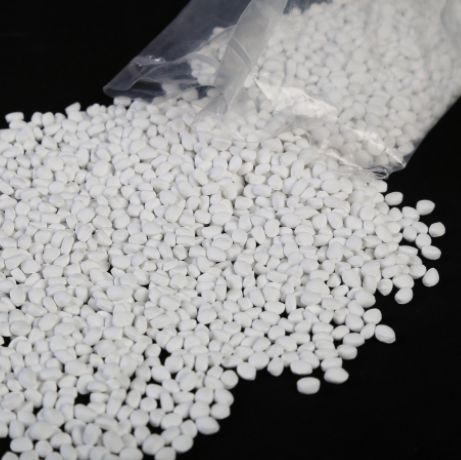

1. Migration resistance (grade) [≥4]
2. Moisture content (%) [≤0.30]
3. Melting temperature (℃) [125~200]
4. Dispersibility of white masterbatch: [zero color dots, streaks]
5. Light fastness (grade) [5-8]
6. The white masterbatch has a granular appearance, uniform particles, and consistent color.
7. Heat resistance (grade) [≥4]
8. Total Chromatic aberration [≤1.50]
In theory, white masterbatches that meet the above technical indicators are of good quality

1. Whiteness
The whiteness of the white masterbatch is mainly represented by the titanium dioxide in the masterbatch, and there are many factors that affect the whiteness of the titanium dioxide, including the size, shape and particle size distribution of the titanium dioxide particles, the type and content of impurities, and the crystal lattice of the titanium dioxide particles. Defects.
In the market, many masterbatch manufacturers replace part of titanium dioxide by adding calcium carbonate, barium sulfate, and zinc sulfide with equal ash content. In fact, the whiteness of these inorganic powders is incomparable with titanium dioxide.
2. Hiding power
Hiding power is also a very important indicator of white masterbatch. Good covering power means that the pigment has strong tinting power, and the desired effect can be obtained with a small amount of addition.
The hiding power of white masterbatch depends on the selection and processing technology of titanium dioxide. Compared with anatase titanium dioxide, rutile titanium dioxide has a smaller and tighter unit lattice and a larger refractive index, so the hiding power and The anti-ultraviolet light performance is obviously better than that of anatase.
Similarly, the hiding power of common calcium carbonate, barium sulfate, and zinc sulfide is not comparable to that of titanium dioxide.

From the above refractive index comparison, it can be seen that the difference in refractive index between rutile titanium dioxide and the carrier PE resin is the largest, the dispersion effect is the best, and the hiding power is the strongest tinting power
3. Dispersion
Dispersibility has an important influence on the application of titanium dioxide in plastics. Generally speaking, the finer the titanium dioxide particles, the better the dispersion and the higher the tinting strength. When the film needs fine printing, use a white masterbatch with excellent dispersibility. The pattern clarity, layering, and vividness of the grains are better. This is because the microscopic smoothness of the base film is one of the determinants of the quality of the printed pattern.
4. Moisture content
The moisture content in the white masterbatch also has an important influence on the performance of the masterbatch. Generally, the moisture content should be controlled below 1500ppm, and the strict requirements should be below 600ppm.
In the injection molding process, the raw materials are generally dried before production. In the production of thin films, customers buy them pre-mixed with the carrier and use them directly. If the water content of the masterbatch is high, it will directly lead to film rupture, and some small bubbles, "crystal points", etc. will be formed on the film. Defects, and the reasons for the high water content of the white masterbatch are affected from the raw materials selected for the masterbatch to the process.
5. Smell
Some film manufacturers will smell a strange smell after using white masterbatch, which is absolutely not allowed in milk films and films in contact with food.
This is mainly because the titanium dioxide in the color masterbatch is in the organic treatment process, and the selected coating additives are inappropriate or the addition amount is too large, or the dispersant selected in the masterbatch production process has problems, and the white masterbatch can be replaced.
6. Hue selection
Rutile titanium dioxide has a "yellowish" tint due to its low reflectivity in the violet light region, and the "yellowish" tint will make the colored product feel "stale" and make finely printed images bright Decreased texture and layering, which is unwelcome among many white masterbatch users.
However, after adding a small amount of fluorescent whitening agent to titanium dioxide, it can absorb ultraviolet light with a wavelength of 300-400nm and convert it into blue fluorescence with a wavelength of 400-500nm, which can make the white masterbatch appear "blue phase", white Masterbatch users can then consider according to their own needs.
7. Liquidity
The fluidity of the white masterbatch can be expressed as a melt index (MI), with a low value of poor flow, a high value of good flow, and good flow means good processing performance, low machine torque, and low power consumption.
8. Printing heat-sealing performance
White film products need printing and heat sealing in most cases. If calcium carbonate is added to the white masterbatch, it will affect the clarity and vividness of the printed pattern. Incorrect or excessive dispersant added to the masterbatch will also affect heat sealing and heat sealing. Printing performance
9. Lightfastness and weatherability
White masterbatch generally requires light fastness of 7-8, weather resistance of 4-5, and temperature resistance of 280 degrees. These requirements mainly depend on the quality of titanium dioxide. To achieve the above conditions, it must be rutile titanium dioxide. .
10. RoHS&FDA
Heavy metal detection and food contact approval are also important indicators of white masterbatch, because many white films will be used in food packaging, and FDA food certification is a must-have test
Contact us to learn more about our masterbatch.
gzplastics666@outlook.com
OUR MASTERBATCH RANGE (Click to Know More details)
* Color masterbatch
* Black masterbatch
* White masterbatch
* Additive masterbatch
* Filler masterbatch


